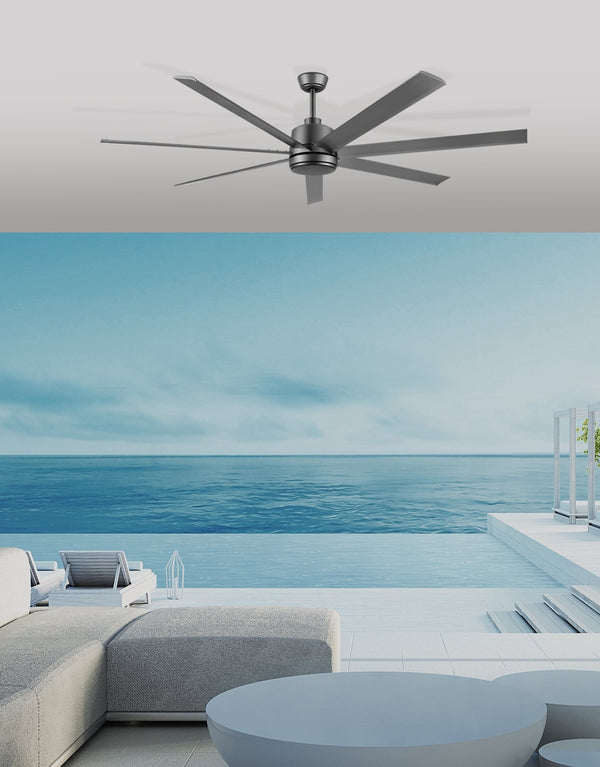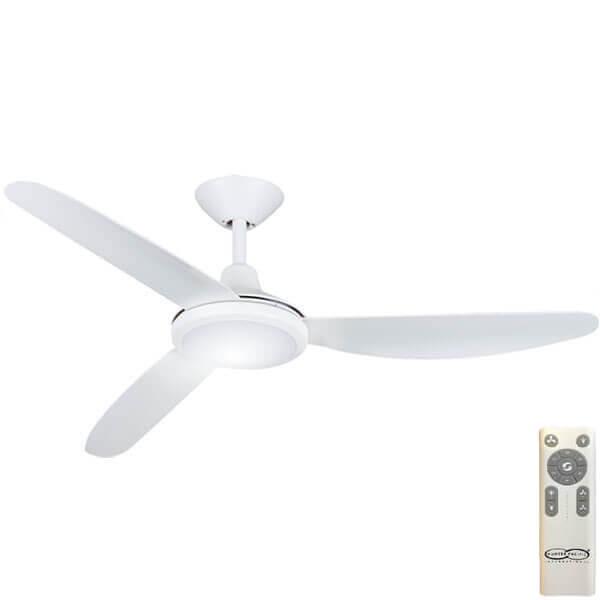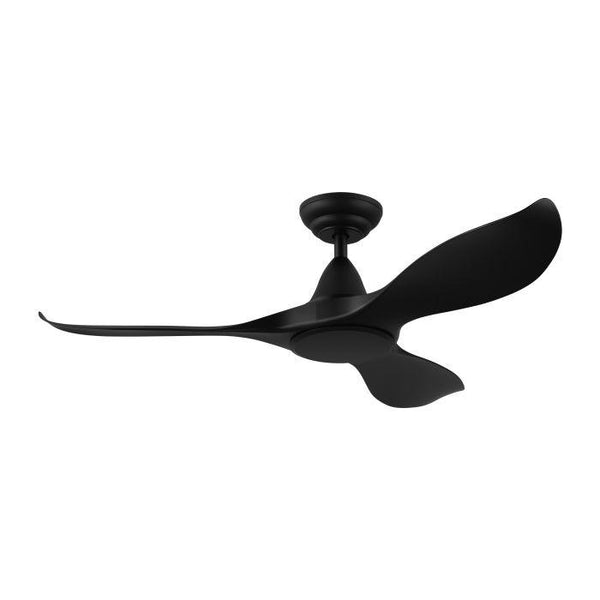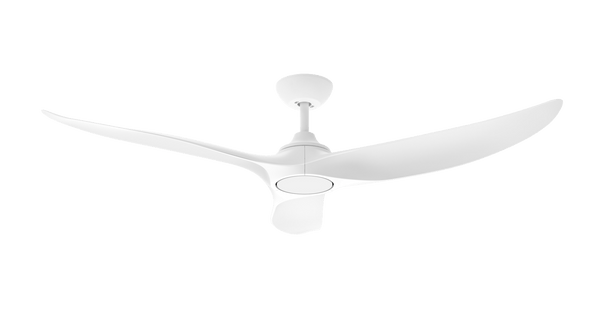




















Match the fan's blade span to your room's floor area. As a rule of thumb, a fan of about 42 to 48 inches (1070 to 1220 mm) suits a room up to 3 by 3 metres, 48 to 52 inches suits up to 4 by 4 metres, 52 to 56 inches suits up to 5 by 5 metres, and 56 inches or more suits large open-plan spaces. Then check your ceiling height, because it decides whether you need a downrod and how the fan will sit.
If you would rather be guided, the Fan Selector asks about your room, motor type, size and light, then takes you to the matching range.
Ceiling fan size chart by room
The blade span is the diameter of the circle the blades sweep, measured tip to tip. It is the number that decides how much air the fan can move in your room.
| Room size | Typical rooms | Blade span |
|---|---|---|
| Up to 9 m² (about 3 x 3 m) | Small bedroom, study, nursery, walk-in robe | 42 to 48 in (1070 to 1220 mm) |
| 9 to 16 m² (up to 4 x 4 m) | Standard bedroom, home office, dining room | 48 to 52 in (1220 to 1320 mm) |
| 16 to 25 m² (up to 5 x 5 m) | Master bedroom, family room, large living room | 52 to 56 in (1320 to 1420 mm) |
| 25 to 36 m² (up to 6 x 6 m) | Open-plan living and dining, large alfresco | 56 to 60 in (1420 to 1520 mm) |
| Over 36 m² or very high ceilings | Great rooms, big entertaining areas | 60 in (1520 mm) or more, or two fans |
These are guides, not hard limits. Rooms are rarely square, so measure the floor area and use the table as a starting point. In a long, narrow room, two smaller fans spaced along its length usually work better than one large fan.
Check your ceiling height before you buy
Ceiling height affects both comfort and safety. Most manufacturers specify that the blades must sit at least 2.1 metres above the floor, and the best airflow comes when the blades are roughly 2.4 to 2.7 metres up. A downrod lowers the fan on high ceilings so the blades sit in that range.
| Ceiling height | Approximate downrod |
|---|---|
| 2.4 m | Flush-mount or low-profile fan (see below), because a standard fan's blades would sit close to the 2.1 m minimum |
| 2.7 m | None, close-mounted |
| About 3.0 m | About 300 mm |
| About 3.6 m | 600 to 900 mm |
| 4 m or higher | 1.0 to 1.2 m, or longer |
Treat these as approximate. A fan body typically hangs about 30 cm below its mount, so a simple check is to take your ceiling height, subtract the downrod and about 30 cm, and see whether the blades land between 2.4 and 2.7 metres. Your fan's manual is the final word. Downrods are model-specific, so check the fan accessories range for one that matches your fan, and ask your electrician before ordering. On a sloped or raked ceiling, also check the fan's maximum mounting angle.
Low ceilings: flush and low-profile fans
On ceilings of about 2.4 metres or lower, a standard fan may hang too low. Flush-mount (or low-profile) fans sit close to the ceiling and keep the blades above head height. In our range, the Eglo Iluka DC flush fan is available in 52 and 60 inch spans, and the Brilliant Costa 52 inch low-profile DC fan is another option. Both are DC models. A low-profile fan moves slightly less air than the same span on a downrod, so size up where you can.
Bigger is not always better
It is tempting to choose the largest fan that fits. In a small bedroom, a very large fan on its top speed can feel like a draught, and it can dominate the room visually. What helps is a DC motor with a wide range of speeds, so you can run the fan gently. The Hunter Pacific Polar V2 lists as little as 3 watts, and the Ventair Glacier 900 mm lists a lowest speed of 2.5 watts, so both can run quietly overnight. For the motor differences, see our AC, DC and EC guide.
Outdoor and alfresco areas
Outdoors, air is not contained by walls, so choose one size up from what you would use inside for the same area, and consider two fans for long patios. Outdoor fans also need the right rating for the position. Our guide to outdoor ceiling fans explains covered, exposed and coastal spaces.
Example fans at each size
- 36 in (900 mm): Ventair Glacier DC 900 mm for small rooms.
- 40 in (1020 mm): Eglo Surf DC 1020 mm for compact bedrooms and studies.
- 48 in (1220 mm): the Polar V2 above for standard bedrooms.
- 52 in (1320 mm): Eglo Surf DC 1320 mm with LED light and remote for larger bedrooms and living areas.
- 56 in (1420 mm): Mercator Guardian IP55 DC for large living and outdoor areas.
- 60 in (1520 mm): Eglo Kurrawa DC with light for big rooms and alfresco areas.
- 72 in (1830 mm): Eglo Tahiti DC for very large spaces.
To browse by size, see medium ceiling fans and large ceiling fans.
Frequently asked questions
What size ceiling fan do I need for a 4 by 4 metre room?
A fan of 48 to 52 inches (1220 to 1320 mm) suits a room of about 16 square metres. Choose the larger size if the room is a living area or the ceiling is high.
Is a 52 inch ceiling fan too big for a bedroom?
Not for a standard bedroom of 9 to 16 square metres, and 52 inches is one of the most common spans we stock. In a very small bedroom, choose a 42 to 48 inch fan, and pick a DC model with low speeds so it never feels like a draught.
How high should a ceiling fan be from the floor?
Blades should be at least 2.1 metres above the floor, and about 2.4 to 2.7 metres gives the best airflow. Use a downrod on higher ceilings.
Can I put a ceiling fan on a low ceiling?
Yes, with a flush-mount or low-profile fan that sits close to the ceiling. Check the clearance above head height before you buy.
Should I get one big fan or two smaller fans?
For a long, narrow or very large space, two smaller fans usually spread the air more evenly than one large fan. For a square room, a single correctly sized fan is better.
Ready to choose?
Use the Fan Selector, or browse all ceiling fans. For more on what to look for, read our guide to the best ceiling fans in Australia. Lights For You delivers Australia-wide, and our Ashfield showroom in Sydney is open if you want to see the sizes in person.