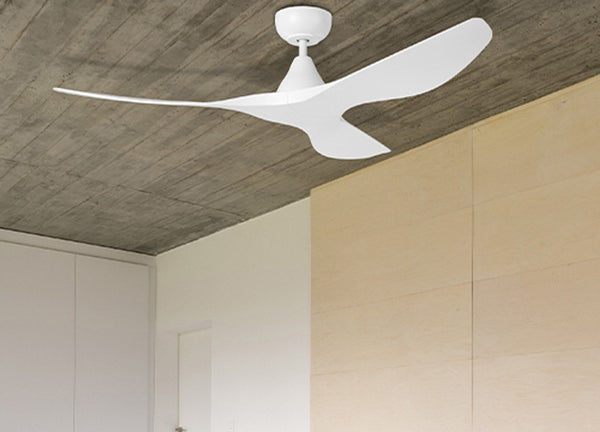


















A ceiling fan is one of the smartest comfort upgrades you can make to an Australian home. It moves air year-round, trims your reliance on air conditioning through summer, and, when paired with a reverse function, helps push warm air back down in winter. But the market has changed a lot, and the fan that would have topped a list a few years ago is not necessarily the one to buy in 2026. This guide walks through exactly what separates a good ceiling fan from a great one this year, how to match a fan to each room, and which brands consistently earn their place on the ceiling.
Rather than hand you a ranked list of model numbers, we have focused on the criteria that actually matter, so you can shop with confidence and choose the right fan for your space. When you are ready to compare options, you can shop ceiling fans across every category mentioned below.
What makes a ceiling fan "the best" in 2026
The single biggest shift over recent years has been the move to DC motors. A DC (direct current) motor draws significantly less power than an older AC motor while delivering the same, or better, airflow. It is also far quieter, which matters enormously in bedrooms and open-plan living. On top of efficiency, DC fans typically offer more speed steps, near-instant reverse for winter, and a soft-start that eases the blades up to speed rather than lurching. If quietness and running cost are priorities, a DC motor is the first box to tick.
Beyond the motor, the best fans in 2026 share a few traits. They come with a proper remote or wall control (often both), they offer a genuine reverse/winter mode, and increasingly they are smart-ready, meaning they can pair with WiFi and a phone app or a voice assistant. Build quality shows up in the details too: sealed motor housings, quality bearings that stay silent over years, and blades that are balanced properly out of the box so you never get that annoying wobble.
Key criteria to weigh up
Motor type and noise. DC motors win on efficiency and silence. If you are sensitive to noise, prioritise a DC fan and look for models described as whisper-quiet.
Blade span versus room size. This is the criterion most people get wrong. Too small a fan in a big room simply cannot move enough air, while an oversized fan in a small bedroom can feel overpowering. As a general rule of thumb: for a small bedroom, study or bathroom (up to roughly 3 by 3 metres), a fan around 42 to 48 inches suits. For a standard bedroom or medium living area, 48 to 52 inches is the sweet spot. For a large living room, master suite or open-plan zone, look at 52 to 56 inches, and for very large or high-ceiling spaces consider 60 inches or more, or even two fans. Ceiling height matters too: for tall or raked ceilings you will want a matching extension downrod so the blades sit at an effective height.
Indoor versus outdoor and coastal ratings. Not every fan can go outside. For alfresco areas, patios and undercover entertaining zones, choose a fan rated for outdoor or damp locations, indicated by an IP rating. If you live near the coast, salt air is brutal on finishes and fixings, so look specifically for fans rated for coastal or marine environments with corrosion-resistant blades and hardware. Fitting an indoor-only fan outdoors will void the warranty and shorten its life.
With or without a light. Many fans are available in both a plain version and a light-kit version, or with a light included. If the fan is your room's main light source, a built-in LED makes sense and keeps the ceiling clean. If you already have good lighting, a fan-only model looks more streamlined and often moves air better.
Smart and WiFi control. Smart fans let you set schedules, adjust speed from your phone, and link fan and light to voice assistants. If you are building a connected home, this is worth paying for. If not, a reliable handheld remote or wall control covers the essentials.
Remote and wall control. Consider how you will actually use the fan day to day. A remote is convenient, but remotes get lost, so a wall controller (or a fan that offers both) is often the more practical long-term choice.
Warranty. A strong motor warranty is a good proxy for how much the manufacturer trusts its own product. Reputable brands back their DC motors for a solid number of years, so always check the terms before you buy.
Best ceiling fans by use-case
Bedrooms. Silence is everything here. A DC motor with multiple low-speed steps lets you find a gentle setting that moves air without noise or a strong draught. A 48 to 52 inch span suits most bedrooms, and a dimmable light kit is handy if the fan doubles as your main light.
Living and open-plan areas. These rooms need reach and presence. Go for a 52 inch or larger DC fan that can shift serious air on high but still run gently for background comfort. A remote or smart control is genuinely useful in a large shared space.
Outdoor and alfresco. Choose a fan built for the job, with a suitable IP rating and weather-resistant blades. Undercover patios and entertaining areas benefit from a larger span to cover the open space, and a coastal-rated model is essential anywhere near the sea.
Large and high-ceiling rooms. Big volumes need big airflow. Look at 56 to 60 inch fans, use an extension downrod to bring the blades to an effective height under raked or high ceilings, and do not be afraid to run two fans in a very large open-plan zone for even coverage.
Trusted brands to look for
Australia is well served by ceiling fan brands that have earned their reputation through reliable motors, sensible design and good after-sales support. When you are comparing options, these names are a safe starting point:
- Hunter Pacific — a long-standing Australian favourite known for quiet, well-engineered DC fans and strong warranties.
- Eglo — broad range spanning stylish indoor fans through to practical outdoor models.
- Mercator — a trusted name with fans to suit almost every room and budget, including plenty of light-kit options.
- Martec — popular for value-focused DC fans with the features most households actually want.
- Brilliant — a wide, accessible range covering indoor, outdoor and smart-ready models.
- Ventair — respected for airflow performance and durable outdoor and coastal options.
Your quick buying checklist
- Choose a DC motor for the best efficiency and quietness.
- Match the blade span to your room size, using the size guide above.
- Check the ceiling height and add an extension downrod for tall or raked ceilings.
- Confirm the fan is rated for its location — indoor, outdoor/IP, or coastal.
- Decide whether you need a built-in light or a fan-only model.
- Pick your control method: remote, wall control, or smart/WiFi.
- Make sure a reverse/winter mode is included for year-round use.
- Check the motor warranty before you commit.
Frequently asked questions
Are DC ceiling fans really worth the extra cost? For most buyers, yes. A DC motor uses less power, runs noticeably quieter and usually offers more speed settings and a smoother reverse function. Over the life of the fan, the efficiency and comfort generally justify the price difference.
What size ceiling fan do I need? Match the blade span to the room. Small rooms suit around 42 to 48 inches, standard bedrooms and medium living areas suit 48 to 52 inches, and large or open-plan spaces suit 52 inches and up. When in doubt, size up slightly and run the fan on a lower speed.
Can I put any ceiling fan outside? No. Only fans rated for outdoor or damp locations should be installed in alfresco and undercover areas, and coastal homes need a corrosion-resistant, coastal-rated model. Installing an indoor fan outside will void the warranty.
Do ceiling fans help in winter? They can. A fan with a reverse mode run on low pushes warm air that has risen back down into the room, helping even out the temperature and easing the load on your heating.
Should I choose a fan with a light? It depends on your room. If the fan will be your main light source, an integrated LED keeps the ceiling tidy. If you already have good lighting, a fan-only model looks cleaner and focuses purely on airflow.
Ready to find your fan?
The best ceiling fan is the one matched correctly to your room, your climate and the way you live. Once you have your size and features in mind, browse the full range and shop ceiling fans from the trusted brands above. Lights For You offers fast delivery Australia-wide, and if you would rather see and compare fans in person, our Ashfield showroom in Sydney is open for you to drop in, feel the quality and get expert advice before you buy.
Shop Ceiling Fans at Lights For You
Browse our full Ceiling Fans range, or start with a few popular picks: