



















A ceiling fan does not lower the temperature of a room. It moves air across your skin so you feel cooler, and it does that using a few watts to a few tens of watts. An air conditioner actually removes heat and moisture from the room, but its power draw is measured in kilowatts. For many Australian summer days and nights a fan is enough on its own; in a heatwave, in humid weather or in a room that holds the heat, an air conditioner does what a fan cannot, and the two work well together.
This guide compares how each one cools you, what they draw in running watts, and how to decide which a room needs. We compare power only, in watts, because what that power costs depends on your tariff and how long you run each appliance.
How a ceiling fan cools you
A fan creates a breeze. Moving air carries heat away from your skin and helps sweat evaporate, which is why you feel cooler under a fan even though the thermometer has not moved. This has two practical consequences:
- A fan cools people, not rooms. Running a fan in an empty room achieves very little, so switch it off when you leave.
- Direction matters. In summer the blades should push air down onto you. Our guide to which way a ceiling fan should spin explains the summer and winter settings.
How an air conditioner cools you
A refrigerated air conditioner, such as a split system, pumps heat out of the room and removes moisture from the air as it goes. The room itself gets cooler and drier, which is why it keeps working when the air outside is hot and sticky. The trade-off is power: the compressor that does this work draws far more than a fan motor. A split system's rated input power is shown in kilowatts on its Energy Rating label, so that is the figure to compare.
Running watts compared
The table below uses the power figures stated on our product pages for a selection of ceiling fans. A fan's figure usually refers to its top speed, and most of the time you will run it lower.
| Appliance | Stated power |
|---|---|
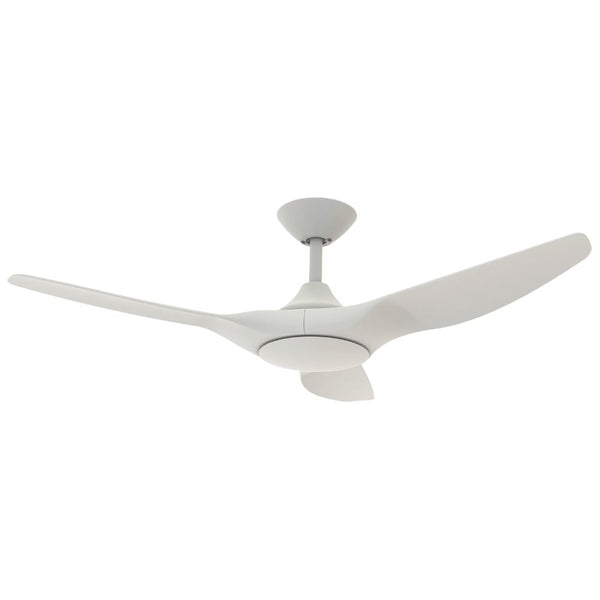
| Hunter Pacific Polar V2 DC fan | As little as 3 W on its lowest speed |
| Brilliant Amari 56 inch DC fan | 35 W DC motor |
| Eglo Aloha 52 inch DC fan | 40 W motor |
| Brilliant Tempest 52 inch AC fan | 50 W AC motor |
| Hunter Pacific Concept 52 inch AC fan | 12.5 W to 62 W, depending on speed |
| Split-system air conditioner | Rated in kilowatts (1 kW is 1,000 W); check the input power on its Energy Rating label |
Even the most powerful fan in that list draws a small fraction of a kilowatt. That is the whole case for a fan in one line: for the same hour of comfort, it asks for far less electricity. If your fan has a light, remember the light adds its own watts. The Polar V2's optional LED light, for example, is listed at 18 W.
When a ceiling fan is enough
- Warm, dry days. When the air is warm but not oppressive, a breeze is often all you need.
- Sleeping. Many people sleep well under a fan on a low setting, and a DC fan on its lowest speed draws very little through the night.
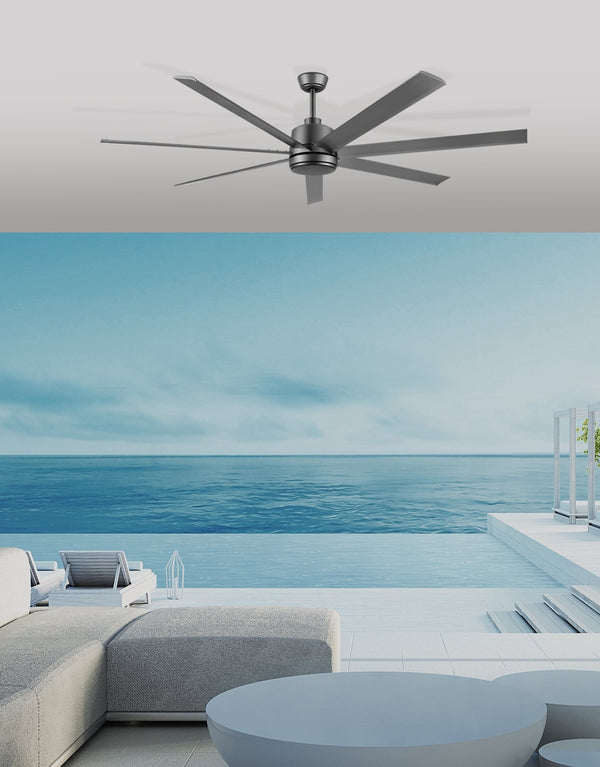
- Covered outdoor areas. An air conditioner cannot cool an alfresco or verandah, but a fan rated for outdoor use can make it comfortable.
- Spring and autumn. In the shoulder seasons a fan can cover the warm afternoons without running the air conditioner.
- Rooms you are in for a while. Because a fan cools people, it suits bedrooms, living rooms and studies where someone is sitting under it.
When you need air conditioning
- Heatwaves. When the air itself is very hot, moving it around brings less relief, and you need the room to actually cool down.
- High humidity. In humid weather, sweat evaporates slowly and a breeze does less. An air conditioner also dries the air.
- Rooms that trap heat. West-facing rooms, top-floor rooms under a hot roof and rooms with a lot of glass can stay hot long after sunset.
- Anyone sensitive to heat. For babies, older people or anyone unwell, follow health advice during extreme heat and do not rely on a fan alone.
Using a fan and an air conditioner together
This is often the best answer. A ceiling fan spreads the cool air from a split system around the room, and the breeze lets you feel comfortable at a slightly warmer thermostat setting. Set the fan to its summer direction and a low or medium speed, and let the air conditioner do the heavy lifting only when the room needs it. On milder days, try the fan on its own first.
Choosing an efficient ceiling fan
Motor type. DC motors are known for low power draw and more speed settings, which is why so many of the fans in the table above are DC. Our guide to AC, DC and EC ceiling fan motors explains the differences in detail. Browse DC ceiling fans to compare models.
Speeds and controls. More speeds means you can find the lowest setting that keeps you comfortable. A remote or wall controller makes it easy to turn the speed down as the evening cools.
Size. A fan that is too small for the room has to run faster to move enough air. Our ceiling fan size guide matches blade span to room size.
Where you will use it. For an alfresco, verandah or coastal home, choose a fan rated for outdoor use. The full range is in ceiling fans.
Frequently asked questions
Does a ceiling fan cool a room?
Not in the sense of lowering the temperature. A ceiling fan makes you feel cooler by moving air across your skin. The room temperature stays about the same, which is why a fan is best used when someone is in the room.
How many watts does a ceiling fan use?
It depends on the motor and the speed. In our range, stated figures run from as little as 3 W on a DC fan's lowest setting up to around 62 W for an AC fan on high. An integrated light adds its own wattage.
Does a fan use less power than an air conditioner?
Yes, by a wide margin. Ceiling fans draw watts or tens of watts, while a split-system air conditioner's rated input is measured in kilowatts. What that means for your bill depends on your tariff and how long each one runs.
Should I run a ceiling fan with the air conditioner on?
Yes, it often helps. The fan spreads the cool air and the breeze makes the room feel cooler, so you may be comfortable with the thermostat set a little higher.
Can I leave a ceiling fan on all night?
Ceiling fans are designed for long running periods, and many people run them overnight on a low speed. A DC fan with a sleep or timer function lets you set it to switch off later in the night.
Are DC ceiling fans more energy efficient?
DC fans generally draw less power than AC fans of a similar size, especially at low speeds, and they usually offer more speed settings. Compare the stated wattage on each product page.
Find the right fan for your summer
We are Lights For You, a Sydney lighting and ceiling fan specialist with a showroom in Ashfield, and we deliver across Australia. If you are weighing up a fan for a particular room, our team is happy to talk through size, motor type and controls with you.