

















In Australia, most commercial, industrial and shared residential buildings need emergency lighting and illuminated exit signs, and the standard behind them is AS/NZS 2293. The lights must come on by themselves when the mains power fails, run from their own batteries long enough for people to get out safely, and be inspected and tested on a regular schedule with the results recorded. A licensed electrician installs them, and the layout for a building is designed and signed off by a qualified person, not chosen from a product page.
This guide explains the terms you will meet, what the different fittings do and what to ask before you buy. It is general information to help you have a better conversation with your electrician or fire safety practitioner, not compliance advice for a particular building. If you already know what you need, browse our emergency lights and exit signs.
Who needs emergency lighting?
The obligation comes from the National Construction Code, which sets out which classes of building need emergency lighting and exit signs, and from AS/NZS 2293, which covers how the system is designed, installed and maintained. In broad terms, workplaces, shops, offices, warehouses, car parks, apartment common areas and public buildings are the places where you will find it. A standalone family home is generally not one of them.
Whether a particular building needs it, and how many fittings go where, depends on its classification, size, layout and the paths people use to leave it. That is a design question for a qualified professional. If you are a landlord, strata manager or business owner and you are not sure what applies, start with the fire safety records for your building and the practitioner who certifies them.
Exit signs and emergency lights are different jobs
People often say "emergency lighting" when they mean the whole system, but there are two kinds of fitting doing two different jobs.
| Fitting | What it does | Where you see it |
|---|---|---|
| Exit sign | Shows the way out with a running-man legend and arrows, and stays readable when the power fails | Above exit doors, along corridors, at junctions where the route changes direction |
| Emergency light (luminaire) | Lights the floor of the escape path so people can see where they are walking | Ceilings of corridors, stairs, open floors and car parks |
| Emergency batten | A normal working batten with a built-in emergency battery | Warehouses, plant rooms, garages and back-of-house areas |
| Twin spot | Two adjustable heads aimed along a path or across a large space | Loading docks, stairwells, outdoor paths and open areas |
Maintained and non-maintained
A non-maintained emergency light is off in normal use. It charges quietly from the mains, and only lights up when the power fails. That is why a correctly working emergency light can look dead on the ceiling: it is waiting.
A maintained fitting is lit all the time and keeps going on its battery when the power fails. Exit signs are normally lit continuously, because a sign people cannot see on an ordinary day is not doing its job. Some battens are rated for either mode, which lets the same fitting work as everyday lighting in one area and as a dedicated emergency light in another.
The numbers on an emergency fitting
Classification (D40, D63 and similar). Emergency lights carry a classification code that a designer uses to work out how far apart they can be spaced. The number is not a brightness rating you can compare like lumens. In general, a fitting with a higher classification covers more ground, so a long corridor needs fewer of them. The designer reads the spacing from the tables in the standard.
Viewing distance. For an exit sign, the key number is how far away the legend can be read. A sign rated for a 24 metre viewing distance can be spaced further apart than one rated for less, and you should never swap a shorter-distance sign into a layout designed around a longer one.
Battery duration. The standard sets a minimum time the fitting must run on its battery. Product pages state what each fitting achieves, and your designer checks that against the requirement.
Battery type. Many current fittings use lithium iron phosphate (LiFePO4) batteries. Whatever the chemistry, the battery is the part that ages and the part that fails a discharge test first, so a fitting with a replaceable battery is easier to keep in service.
Testing and maintenance
Emergency lighting is a system you have to keep proving works. AS/NZS 2293.2 covers routine inspection and maintenance, and it calls for regular checks plus periodic discharge tests, where the mains supply is cut and each fitting must run on its battery for the required time. Every test is logged, and the logbook is part of the building's fire safety records.
In practice, building owners engage an electrician or fire services contractor to do this. Two features make the job much easier: a test switch on the fitting, and an indicator light that shows it is charging. Battery replacement is a normal part of maintenance, and many fittings are replaced over their life simply because the battery could not be changed.
Who can install and certify it?
Emergency lights and exit signs are hard-wired to the building's electrical supply, so they must be installed by a licensed electrician. The layout is designed by a qualified person, and the system is certified as part of the building's essential fire safety measures. Many states also require the owner to confirm each year that these measures are being maintained. Buying the fittings is the easy part; the design, installation, testing and paperwork are where the obligations sit.
Emergency fittings we stock
These are examples from our range, chosen to show the main types. Your electrician or designer will confirm which suit your building.
Exit sign. The Domus EXIT-SM-24M is a surface-mounted LED exit sign with a 24 metre viewing distance and a 2-hour LiFePO4 battery. It mounts on a wall, a ceiling or suspended, and both single and double-sided decals come in the box, so one model covers a sign seen from one direction and one seen from both. The battery is replaceable.
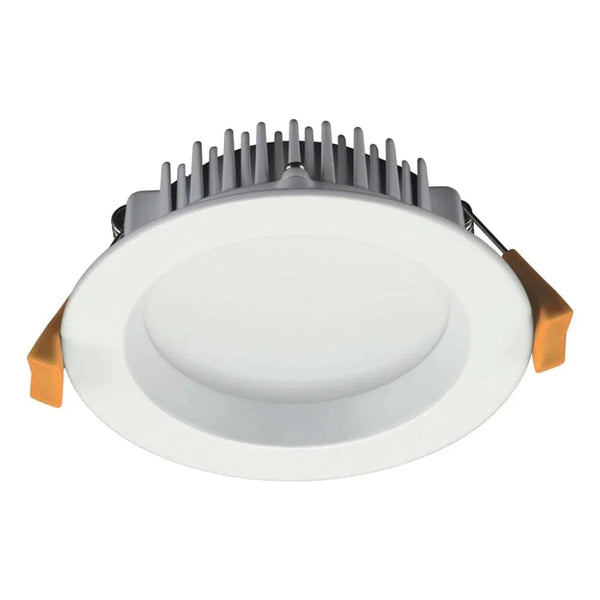
Surface-mounted emergency light. The Domus EVAC-D63-SM is a 3.5 W non-maintained emergency light with a D63 classification. Because it fixes to the surface, it needs no ceiling cutout, which suits concrete soffits and ceilings you would rather not open up.
Recessed emergency light. The Domus EVAC-D40-REC is a small 1.8 W recessed non-maintained fitting with a D40 classification and 239 lumens. On a short corridor or a small tenancy, a D40 can be the right choice; on long paths of travel, a higher classification usually means fewer fittings.
Twin spot. The Domus TWIN-SPOT-EM is a wall-mounted twin-spot with two adjustable heads, an IP65 rating, a LiFePO4 battery, a manual test switch and an LED indicator. Being able to aim each head is what makes a twin spot useful in stairwells, docks and outdoor paths.
Emergency batten. The Domus HYDRO-120-EM is a 1,200 mm IP65 weatherproof batten, switchable between 15 W and 30 W and between three colour temperatures, rated for maintained or non-maintained use and available with an optional sensor. It is a sensible choice for car parks, garages and back-of-house areas, where one fitting does both the everyday and the emergency job.
What to ask before you buy
- Has the layout been designed? Order fittings to a design, not the other way round.
- Maintained or non-maintained? Check which each location needs.
- Which classification or viewing distance? Substituting a lower one changes the spacing.
- Surface or recessed? Check the ceiling type, especially if it is fire rated.
- What IP rating? Car parks, docks and outdoor paths need a weatherproof fitting.
- Is the battery replaceable, and is there a test switch? Both reduce the maintenance burden.
For the general lighting in the same spaces, see our commercial lighting range and our guide to high bay lighting for warehouses and workshops. Lights For You supplies emergency fittings to electricians and building owners from our showroom in Ashfield, Sydney, and we are happy to check product details against your electrician's schedule.
Frequently asked questions
Does a house need emergency lighting in Australia?
A standalone family home generally does not. The requirement applies to other classes of building, such as workplaces, shops, car parks and the common areas of apartment buildings. If you are unsure about a particular building, ask the practitioner who certifies its fire safety measures.
How often do emergency lights need to be tested?
AS/NZS 2293.2 sets a schedule of routine inspections and periodic discharge tests, and each test must be recorded in a logbook. Your electrician or fire services contractor will work to the current edition of the standard and your building's requirements.
What is the difference between maintained and non-maintained emergency lights?
A maintained fitting is lit all the time and continues on its battery when the power fails. A non-maintained fitting is off in normal use and only lights up when the power fails.
Can I install an exit sign myself?
No. Exit signs and emergency lights are wired into the building's electrical supply, so a licensed electrician must install them, and the system needs to be designed and certified by a qualified person.
What does D40 or D63 mean on an emergency light?
It is the fitting's classification, which a designer uses to work out how far apart the fittings can be placed. It is not a simple brightness figure, so compare classifications, not wattage.
Why does my emergency light look like it is not working?
Most emergency lights are non-maintained, which means they stay off until the mains power fails. Check the charging indicator instead, and have the fitting tested if the indicator is out.