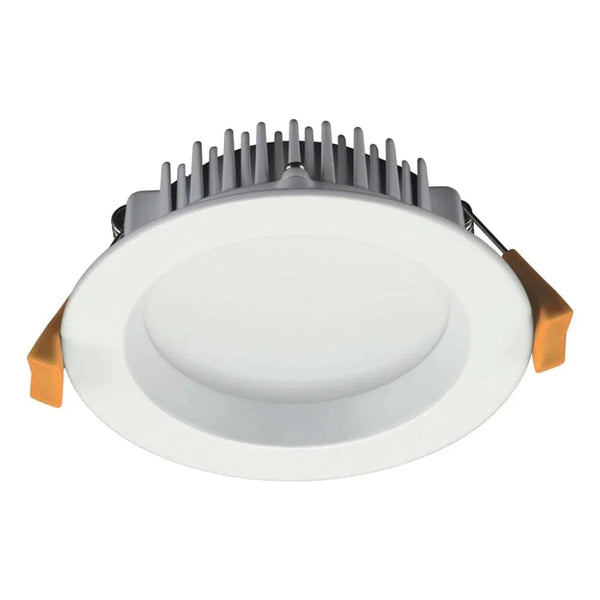

















The most common downlight size in Australian homes is a 90 mm cut-out, the hole in the ceiling the fitting sits in. Most household LED downlights are made for a hole between about 85 and 95 mm, with smaller 65 to 76 mm fittings for a low-key look and 120 to 200 mm fittings for larger or commercial spaces. When you replace an old downlight, measure the hole rather than the old fitting, because the cut-out is the number that decides what will fit.
This guide covers sizes only: the three measurements on every listing, what to do when your hole is a different size, and how to swap out old fittings without patching the ceiling. For brightness, colour and beam angle, our guide to choosing an LED downlight covers the rest.
The three numbers on every downlight
Downlight listings usually quote three sizes, and they are easy to mix up.
- Cut-out. The diameter of the hole in the plasterboard. This is the size that has to match your ceiling.
- Face, or overall, diameter. The visible trim that sits on the ceiling. It is always larger than the cut-out so it covers the edge of the hole.
- Depth, or height. How far the body goes up into the ceiling space. It matters where joists, ducting or a low roof pitch leave little room.
The catch is that product names do not always use the same number. Some are named after the cut-out and some after the face. The Telbix Elon is sold as a 90 mm downlight, and 90 mm is its cut-out; its face is 115 mm and it is 60 mm deep. The SAL S9041 is also sold as a 90 mm downlight, but its listed cut-out is 92 mm, with a 103 mm face and 40 mm height. Both belong to the 90 mm family, yet the hole each one needs is slightly different. Always read the cut-out line on the product page, not the headline.
Downlight cut-out sizes at a glance
Across the downlights in our own range that list a cut-out, 90 mm is by a wide margin the most common figure, followed by 95 mm and 92 mm. This is how the sizes break down.
| Cut-out | What it is | Typical use |
|---|---|---|
| 65 to 76 mm | Compact downlights with a small face | Hallways, joinery bulkheads, low-glare feature lighting |
| 85 to 95 mm | The standard household size, with 90 mm the most common | Living areas, bedrooms, kitchens, most replacements |
| 120 to 160 mm | Larger, higher-output fittings | Big rooms, high ceilings, retail and office spaces |
| 200 mm and over | Large commercial panels and downlights | Shops, offices, warehouses with plasterboard ceilings |
Browse recessed LED downlights to compare cut-outs side by side, or see the full LED downlight range, which also includes surface-mounted fittings that need no hole at all.
Replacing old downlights: measure the hole
The old fitting is not a reliable guide, because its trim hides the real hole. Once the old fitting is out, measure across the hole at its widest point. Plasterboard holes are rarely perfect circles, so take two measurements at right angles and use the larger one.
Then check three more things before you choose:
- Depth above the ceiling. Look or feel for joists, pipes and ducts close to the hole. A low-profile fitting such as the Tradetec Arte Gimbal (90 mm cut-out, 110 mm face, 40.5 mm high) suits a shallow space better than a deeper one.
- Insulation. If ceiling insulation sits around the old fitting, choose a downlight rated to be covered by it. The Elon, for example, is listed as IC-4. Your electrician will confirm what the ceiling needs.
- Wet areas. In a bathroom, laundry or under the eaves, check the IP rating on the listing as well as the size.
Older halogen downlights often ran through a separate transformer in the ceiling space. Modern LED downlights usually come with their own driver, so the old gear generally comes out with the old fitting. Removing old fittings and connecting new ones is work for a licensed electrician.
When the hole is a different size
The hole is slightly bigger than the new cut-out
Work out the overlap. Take the face diameter, subtract the cut-out, and halve it: that is how much trim covers the plaster on each side. The Elon's 115 mm face over a 90 mm hole leaves 12.5 mm all round, which hides a slightly ragged or oversized edge. The S9041's 103 mm face over a 92 mm hole leaves 5.5 mm, which is neat but less forgiving. If your hole is a few millimetres oversize, a fitting with a wider face is the simple fix.
The hole is much bigger
Look for a downlight made for that larger cut-out, or patch the plasterboard and cut a new hole. Our range runs well past the standard size; the 3A recessed LED downlight W225mm, for instance, needs a 200 mm cut-out with a 225 mm face. If you are unsure, bring your measurements in and we will help you find a match.
The hole is smaller
A hole can be enlarged with a hole saw, so a smaller hole is the easier problem. Your electrician will cut it to the new size during installation. Make sure the new face still clears any nearby cornice, wall or joinery.
Compact and adjustable downlights
Smaller cut-outs give a quieter ceiling. The SAL Ripple Effect Shield downlight needs a 76 mm hole with an 82 mm face, so it reads as a small, crisp point of light rather than a wide disc. Fewer, smaller faces can make a ceiling look calmer, though you may need more fittings for the same brightness.
Tilting fittings follow the same rules. A gimbal downlight has a cut-out, a face and a depth like any other, and the tilt happens inside the body. Browse gimbal downlights if you want to aim light at a splashback, artwork or a feature wall. Square downlights need a square hole, so check the listing for the cut-out shape as well as the size.
A quick sizing checklist
- Measure the hole, twice, at right angles. Use the larger figure.
- Read the cut-out on the product page, not the name.
- Check the face covers the hole with some overlap to spare.
- Check the depth against the space above the ceiling.
- Check insulation and wet-area ratings for that room.
- Buy all the fittings for one room together, so trims and colour match.
For a broader look at features and brands, read our LED downlights buying guide.
Frequently asked questions
What is the standard downlight size in Australia?
The most common cut-out is 90 mm. Most household downlights sit between 85 and 95 mm, so a 90 mm fitting is the usual starting point when you replace one.
Is the downlight size the cut-out or the outside diameter?
It depends on the listing. Some product names use the cut-out and some use the face diameter. Always check the cut-out figure in the specifications.
Can I put a 90 mm downlight in a 92 mm hole?
Usually, yes, as long as the face is wide enough to cover the gap and the spring clips can still grip the plasterboard. Check the face diameter on the listing first.
Do LED downlights fit the holes left by old halogen downlights?
Often they do, because many LED downlights are made for the same common sizes. Measure the hole once the old fitting is out, and have an electrician remove any old transformer.
How deep does a downlight need the ceiling space to be?
That depends on the fitting. Low-profile models can be around 40 mm high, while others need 60 mm or more. The depth or height is listed on each product page.
Need a hand matching a size?
Lights For You is a Sydney lighting store with a showroom in Ashfield, and our team can match a cut-out to a fitting if you bring in your measurements or the old downlight. You can also browse every LED downlight online and compare cut-outs on each product page.