


















The quietest ceiling fans are DC and EC/DC models, because their motors run without the hum an AC motor can make and offer more low speeds, where fans are quietest. Beyond the motor, a quiet fan depends on balanced blades, a firmly fitted mount and the right controller. This guide explains what to look for, how to fix a fan that has become noisy, and which fans in our range describe themselves as quiet.
If you want to compare options, browse DC ceiling fans or let the Fan Selector narrow the range by motor, size and light.
What makes a ceiling fan quiet
The motor. A DC motor is brushless and electronically controlled, so it has no mains hum and can run smoothly at very low speeds. An EC/DC motor works the same way and connects directly to mains power. Traditional AC motors are reliable and cost less, but many produce a low hum, especially at lower speeds. Our guide to AC, DC and EC motors has the full comparison.
Low speeds. Every fan is quietest on its lowest setting, and DC fans offer far more steps. The Hunter Pacific Polar V2 lists nine speeds and as little as 3 watts, and the Ventair Glacier DC 900 mm lists 2.5 watts on its lowest speed. That is a very gentle movement of air that you will barely hear.
Balanced blades and a solid mount. Most noise from a ceiling fan comes from wobble, not the motor. A fan that is fitted to a solid mounting bracket, with tight screws and blades that are evenly balanced, runs quietly. Poor mounting, a bent downrod or an out-of-balance blade will make even a high-quality fan click or hum.
The right control. A handheld remote or a wall control designed for the fan keeps the motor running smoothly. An ordinary wall dimmer is not a fan control, and it is a common cause of buzzing in AC fans.
Fans in our range that describe themselves as quiet
We do not publish decibel ratings for our fans, so we cannot rank them by noise. What we can do is point you to the fans whose own product pages describe quiet running, all of which use DC or EC/DC motors.
Hunter Pacific Polar V2 DC. The page describes a super silent brushless DC motor with whisper-quiet cooling on low speeds, in 48 and 56 inch spans, with an optional dimmable LED. View the Polar V2.
Hunter Pacific Evolve EC/DC. An EC/DC motor described as operating quietly and suited to bedrooms, living rooms and offices. View the Evolve.
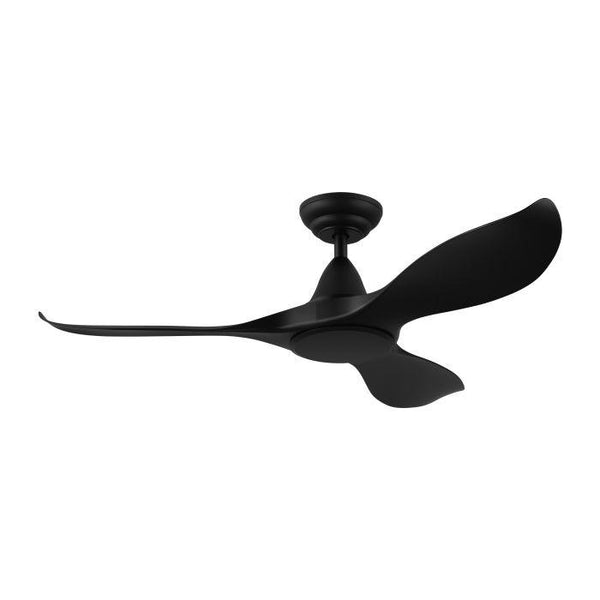
Eglo Noosa DC. A six-speed DC fan with ABS blades, described as delivering quiet, smooth airflow, in 46 inch and 52 inch sizes, with or without a light.
Eglo Surf DC. Another best seller whose page describes quiet, smooth airflow from an energy-efficient DC motor. View the Surf 52 inch.
Eglo Tahiti DC. A six-speed DC fan with IP66 weatherproof protection, described as whisper-quiet and drawing as little as 2.9 watts on its lowest setting. View the Tahiti.
How to fix a noisy ceiling fan
- Switch the fan off and let it stop. Always turn the fan off at the wall before touching it, and do not work on a fan that is still moving.
- Tighten the screws. Check the screws that hold the blades to the blade arms, the arms to the motor, and the mounting bracket to the ceiling. Loose screws are the most common cause of clicking.
- Check the blades. Wipe dust off the blades, because it builds up unevenly and unbalances them. A fan balancing kit helps if one blade sits differently.
- Check the downrod and canopy. The rod should be tight and straight, and the canopy should not touch the ceiling.
- Remove any wall dimmer. If the fan is on a standard light dimmer, replace it with the fan's own control or a wall control made for fans.
- Call your electrician. If the noise continues, a licensed electrician can check the wiring and the mount. Ceiling fans are fixed wiring, so any electrical work must be done by a licensed professional.
Choosing a quiet fan for your room
Match the size to the room, because a fan that is too small has to run faster, and a fast fan is a louder fan. Our ceiling fan size guide has the chart, and our bedroom fan guide covers the room where quiet matters most. For ceilings above about 2.7 metres, see high and sloped ceilings.
Frequently asked questions
What is the quietest type of ceiling fan?
DC and EC/DC fans. Their brushless motors do not hum like many AC motors, and they offer more low speeds.
Why is my ceiling fan so noisy?
Usually because of wobble: loose screws, dust on the blades or a poorly fitted mount. In AC fans, buzzing can also come from a wall dimmer used to control the speed.
Are DC ceiling fans really quieter than AC?
In general, yes, especially at low speeds. We do not publish decibel figures, so the product page descriptions and the motor type are the best guide.
Does a bigger fan run quieter?
A larger fan can move the same air at a lower speed, which is quieter. Choose a size that suits your room rather than a very small fan running hard.
Can I use a normal dimmer to slow a ceiling fan?
No. Use the fan's own remote or a control made for fans. A standard dimmer can cause buzzing and may damage the motor.
Find a quiet fan
Use the Fan Selector, or browse all ceiling fans. Lights For You delivers Australia-wide, and our Ashfield showroom in Sydney is open if you would like to see the fans in person.