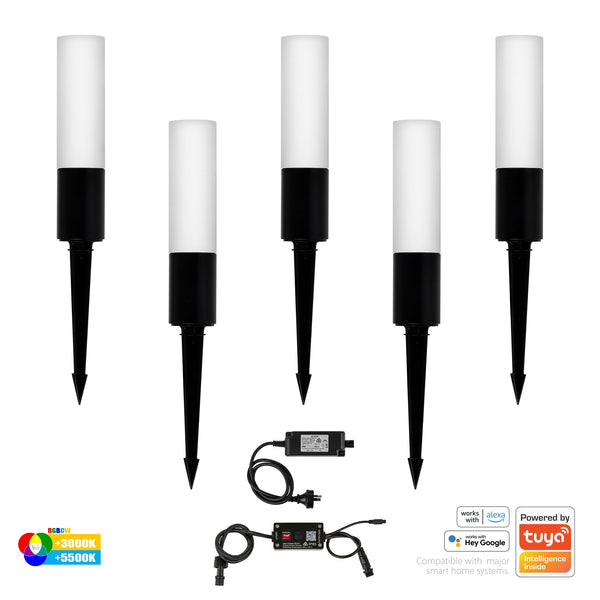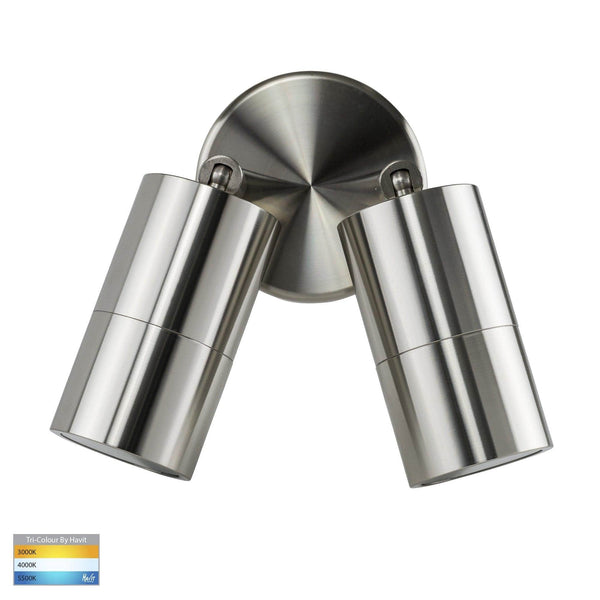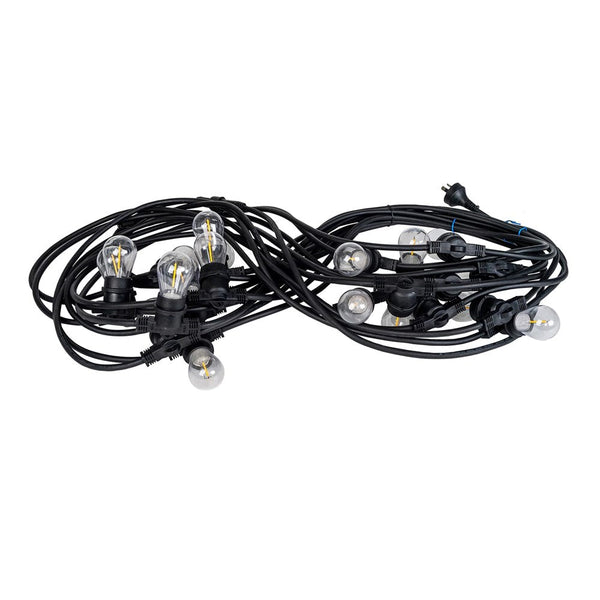



















For most garden beds, 12V (low voltage) lighting is the more flexible choice: the fittings run from a driver that steps mains power down, the cable is easier to reposition and extend, and you can add spike or path lights as the garden grows. 240V garden lighting connects straight to mains, needs no driver, and suits fixed fittings such as bollards and wall lights on a planned cable run, but it must be installed by a licensed electrician. Solar fits where running any cable is impractical, provided the fitting gets enough sun.
Many good gardens use all three. This guide explains how each works, where each fits, and what to ask your electrician. You can browse the full range of 12 volt LED lights and garden lighting as you read.
12V vs 240V vs solar at a glance
| 12V (low voltage) | 240V (mains) | Solar | |
|---|---|---|---|
| Power source | A driver that converts 240V to 12V or 24V DC | Mains wiring, no driver | Built-in panel and battery |
| Installation | Driver supplied from mains; low-voltage cable to each fitting | Licensed electrician for the whole run | No cable to the fitting |
| Flexibility | High: move and add fittings as plants grow | Low: positions are set when the cable goes in | High, but only in sunny positions |
| Output per fitting | Lower to medium, ideal for accent and path light | Medium to high from a single fitting | Depends on the battery and the weather |
| Best for | Spike lights, path lights, step lights, garden beds | Bollards, post tops, wall lights, driveways | Remote corners, long driveways, gates |
How 12V garden lighting works
A 12V system has three parts: a driver (sometimes called a transformer) that converts 240V mains to low-voltage DC, low-voltage cable, and the fittings, usually wired in parallel. The driver is the only part connected to mains power.
The appeal is flexibility. Shrubs grow, beds get redesigned and trees fill out, and a low-voltage spike on a lead can be lifted and re-aimed rather than rewired. That is why most spike lights and path lights in our range are low voltage.
Two 12V fittings we often recommend:
- Domus ZOOM-PRO 12W: a 12V or 24V DC spike light, IP67, with a 40 degree beam and switchable 3000K, 4000K and 5000K. It is a strong choice for uplighting a tree or feature plant. The driver is sold separately.
- Domus SHADOW 2LT Path Spike: a 1 metre twin-head 12V spike, IP65, taking two MR16 lamps, in textured black aluminium or 316 stainless steel. One head lights the path and the other the planting beside it. It needs a 12V DC driver.
Sizing the driver and avoiding voltage drop
Add up the wattage of every fitting on the run and choose a driver with spare capacity, so it does not run at its limit. On long runs, voltage drop can make the fittings at the far end dimmer than those near the driver. Shorter cable runs, heavier cable, or running at 24V rather than 12V (where the fittings support it) all help. Some fittings also set a maximum distance from the driver; check the product page. Browse LED drivers by voltage, wattage and IP rating.
When 240V makes sense
240V fittings connect directly to mains and need no driver. A single 240V fitting can give more light than a typical low-voltage equivalent, and there is no driver to house or replace. The trade-off is that positions are fixed once the cable is in, and the whole installation is licensed electrical work.
The Havit Maxi 600 316 stainless steel bollard shows the difference clearly, because it is sold in both versions. The 240V model takes a 9W E27 globe and gives about 700 to 740 lumens depending on colour temperature, with no driver. The 12V model takes a 5W MR16 and gives about 270 to 300 lumens, runs from a driver, and Havit sets a maximum cable distance from that driver. If the bollards are going in along a new path or driveway where a cable is being run anyway, the 240V version is simpler and brighter.
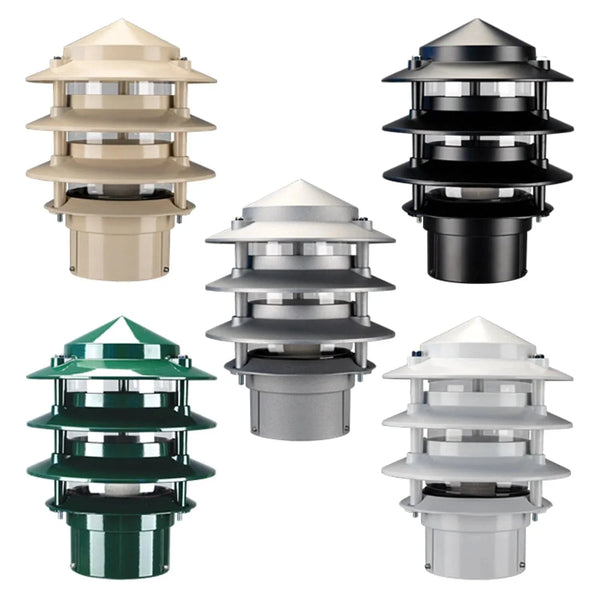
Classic garden fittings such as the Domus BL-100 three-tier bollard head are also mains fittings, taking a standard E27 globe. Note that the BL-100 is the head only: it needs a 76 mm post and a base, sold separately.
Where solar fits
Solar suits positions where running cable would cost more than the light is worth: the far end of a long driveway, a gate, a paddock or a large back yard. Its limits are sun and battery. A solar fitting under a tree canopy or against a shaded wall charges slowly and runs for less time.
- Domus SUNSOLAR-1: a solar post-top area light, 20W LED with 2,100 lumens, IP65, with a 38.4Wh battery. Domus states a 4 to 6 hour charge in good sun and over 32 hours of run time. It is a head only, so it needs a post.
- Mercator Defender solar flood light: a 5W, 500 lumen, 4000K solar flood with a PIR motion sensor, for lighting a path or entry when someone approaches.
Our solar range is small, because solar is a specialist answer rather than a replacement for a wired garden scheme.
Installation and safety
Keep these points general and let your electrician confirm the detail for your site:
- Any 240V garden lighting, including the circuit that supplies a 12V driver, must be installed by a licensed electrician.
- Outdoor drivers and connections need a suitable IP rating and should be mounted off the ground, away from pooling water, and somewhere you can reach.
- Cable type, depth and protection are set by the Australian wiring rules and differ for low-voltage and mains cable. Ask your electrician before you dig.
- Plan the cable route before planting. It is the part of a garden lighting job that is hardest to change later.
Combining the three
A common approach is 240V for the fixed, structural lights (bollards along a driveway, wall lights at the doors), 12V for the garden beds and feature plants, and solar for the one remote corner that would otherwise need a long trench. Whatever you mix, keep the colour temperature consistent across the garden; warm white of around 2700K to 3000K usually looks most natural against foliage. For layout ideas, see our pathway and garden lighting guide and our garden spike lights guide.
Frequently asked questions
Is 12V or 240V better for garden lights?
For garden beds and feature plants, 12V is usually better because fittings can be moved and added easily. For fixed fittings on a planned cable run, such as bollards and wall lights, 240V is simpler and can be brighter per fitting.
Do 12V garden lights need a transformer?
Yes. A 12V fitting runs from a driver, often called a transformer, that converts 240V mains to 12V DC. Connecting a 12V fitting directly to 240V will destroy it.
Can I install 12V garden lights myself?
Rules on who can install low-voltage garden lighting vary with how it is supplied and connected. The 240V side, including any fixed wiring to the driver, is work for a licensed electrician. Ask your electrician which parts of your plan you can do.
Are solar garden lights as bright as wired lights?
Some are. A well-specified solar fitting with a large battery can match a small mains bollard, but output and run time depend on sun and season. Wired lights are more consistent.
How many lights can one driver run?
Add up the wattage of all the fittings and choose a driver rated comfortably above the total. Long runs may also need a shorter cable path, heavier cable or 24V to avoid voltage drop.
Plan your garden lighting
Start with the 12 volt LED lights range for beds and paths, and add mains or solar where they suit. If you are in Sydney, bring a sketch of your garden to the Lights For You showroom in Ashfield and we will help you work out fittings, drivers and cable runs before your electrician starts.