


















A good ceiling fan does more than move air. It keeps a room comfortable through hot Australian summers, takes the load off your air conditioner, and can even help circulate warmth in winter. But with so many options, choosing the right one can feel overwhelming. This guide walks you through everything that matters: DC vs AC motors, blade size, materials, indoor and outdoor ratings, light kits, smart controls and more, so you can buy with confidence.
DC vs AC ceiling fans: what's the difference?
The biggest decision you'll make is the motor type. Every ceiling fan runs on either an AC (alternating current) or a DC (direct current) motor, and the difference affects running costs, noise, speed options and price.
AC ceiling fans
AC motors have been the industry standard for decades. They connect directly to your mains power, are reliable and typically cost less upfront. Most AC fans offer three speed settings and can be operated by a wall switch, pull cord or remote. If you're after a straightforward, budget-friendly fan for a bedroom or living area, an AC model is a solid choice.
DC ceiling fans
A DC ceiling fan uses a motor that converts mains power to direct current, and this is where the advantages stack up. When you weigh up DC vs AC ceiling fan options, DC generally wins on:
- Energy efficiency — DC motors typically draw significantly less power than comparable AC motors, so they cost less to run over the life of the fan.
- Quietness — DC motors run smoother and quieter, which is ideal for bedrooms and nurseries where you want airflow without the hum.
- More speeds — DC fans commonly offer six or more speed settings, giving you finer control over airflow.
- Remote included — Because DC motors need electronic control, most come with a remote as standard, often with reverse and timer functions.
- Faster start and reverse — DC motors change speed and direction quickly and smoothly.
The trade-off is a higher upfront price. Over time, though, the lower running costs of a DC fan can offset that difference, especially if the fan runs for many hours a day. Brands like Hunter Pacific, Ventair and Martec offer excellent DC ranges if efficiency and quiet operation are your priorities.
Choosing the right blade size for your room
Blade span (the diameter of the fan) is the single most important sizing factor. A fan that's too small won't move enough air; one that's too large can overwhelm a small space. Blade span is usually measured in millimetres or inches.
As a general guide:
- Small rooms such as bathrooms, studies and small bedrooms (up to around 9 square metres) suit a compact fan of roughly 900mm to 1100mm (36" to 44").
- Standard bedrooms and medium rooms (around 9 to 20 square metres) work well with a 1200mm to 1300mm (48" to 52") fan, the most common size sold.
- Large living areas, open-plan spaces and master bedrooms (over 20 square metres) benefit from a 1400mm (56") fan or larger to move air effectively across the space.
For very large or long rooms, two smaller fans can sometimes distribute air more evenly than one oversized fan. If you're unsure, size up rather than down; a larger fan on a lower speed moves plenty of air quietly.
Blade count and materials
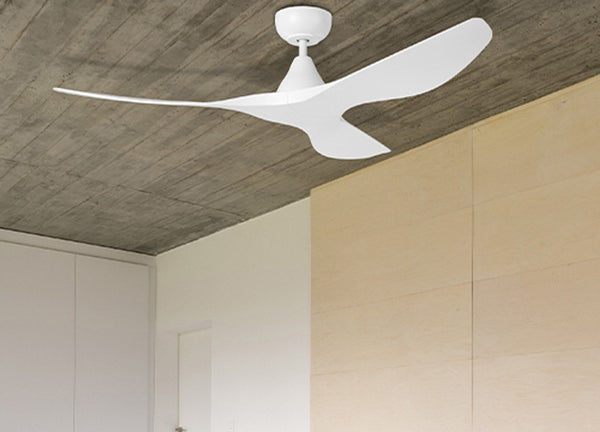
You'll see fans with anywhere from two to five (or more) blades. Blade count has a modest effect on performance and a bigger effect on looks. More blades can mean slightly quieter operation, while fewer blades often suit a sleek, modern aesthetic. In practice, the motor and overall design matter more than blade count alone.
Common blade materials include:
- ABS plastic — Lightweight, durable and often moisture resistant, making it a popular all-rounder and a smart pick for outdoor and undercover areas.
- Timber — Warm and classic, ideal for adding a natural touch to living rooms and bedrooms. Best suited to indoor use.
- Metal (aluminium) — Strong and contemporary, often used on high-performance and modern designer fans.
Mercator, Brilliant and Eglo all offer fans across these material types, so you can match the finish to your interior.
Indoor vs outdoor: IP ratings and coastal conditions
Not every fan is built for every location. If you're installing on a covered patio, alfresco area, verandah or in a bathroom, you need a fan rated for those conditions. Look for an appropriate IP rating, which indicates protection against moisture, and blades made from weather-resistant materials like ABS.
If you live near the coast, salt air is a serious consideration. Salt accelerates corrosion, so look for fans specifically rated for coastal environments. Models built with 316 marine-grade stainless steel components are designed to withstand salt-laden air and are the safest choice for beachside homes. Always check that the fan's warranty covers coastal installation before you buy.
Fans with a light versus fans without
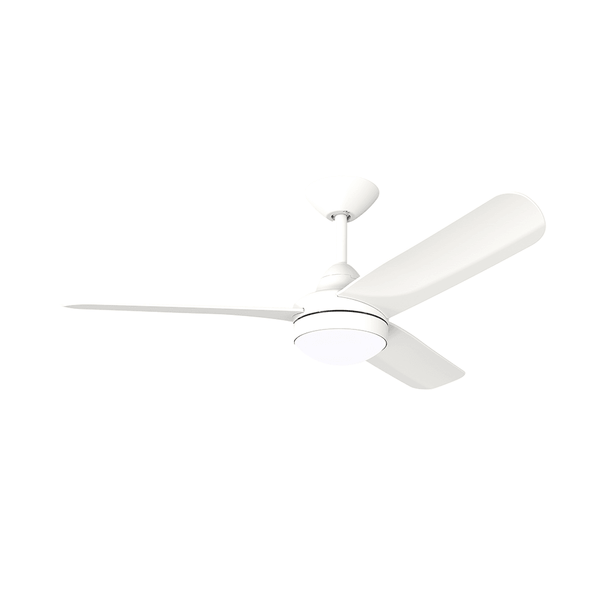
A ceiling fan with light is a space-saving, two-in-one solution, giving you airflow and illumination from a single fixture. This is perfect for bedrooms and living areas where you want to keep the ceiling uncluttered or where there's only one wiring point.
Most modern fans use an integrated LED light kit, which is energy efficient, long lasting and often dimmable. Some models let you switch between warm and cool white light to suit the mood. If you already have plenty of lighting, or you want maximum airflow performance, a fan without a light keeps things simple and can run slightly quieter. Many ranges offer the same fan in both light and no-light versions, so you're not locked in.
Smart and WiFi ceiling fans
Smart fans connect to your home WiFi so you can control them from your phone or with voice assistants like Google Assistant and Amazon Alexa. You can adjust speed, toggle the light, set schedules and turn the fan on before you even get home. If you already run a smart home, a WiFi-enabled fan slots in neatly. Brilliant, Martec and Mercator all offer smart-capable models. Even without full smart features, most DC fans include a handy remote with timer and reverse functions built in.
Downrods and sloped ceilings
The downrod is the pole that drops the fan from the ceiling mount. Getting the drop right is important for both safety and performance. For standard ceilings, the included downrod is usually fine. For high or raked ceilings, a longer downrod lowers the fan to the ideal height, generally at least 2.1 metres above the floor and around 300mm below the ceiling for good airflow.
If you have a sloped or angled ceiling, check that the fan supports an angled mount or that a compatible sloped-ceiling adaptor is available. Not every fan accommodates steep pitches, so confirm this before purchasing. Our team can help you work out the right downrod length for your space.
Controls: remote, wall and smart
How you operate your fan comes down to preference and wiring:
- Remote control — Standard on most DC fans and available on many AC models. Convenient and easy to retrofit.
- Wall control — A neat, fixed control that replaces or sits beside your light switch. Great if you don't want to misplace a remote.
- Smart control — App and voice control via WiFi, ideal for connected homes and scheduling.
Many fans support more than one control method, so you can mix and match to suit your household.
Quick size chart summary
To recap the sizing at a glance: for small rooms like studies and small bedrooms, choose a fan around 900mm to 1100mm. For standard and medium rooms such as most bedrooms, a 1200mm to 1300mm fan is the sweet spot. For large living areas and open-plan spaces, step up to 1400mm or larger, and consider two fans for very long rooms. Match the blade material and IP rating to the location, and pick a DC motor if quiet, efficient running is a priority.
Frequently asked questions
Are DC ceiling fans worth the extra cost?
For many homes, yes. A DC ceiling fan uses less energy, runs more quietly and offers more speed settings, with a remote usually included. If the fan runs for long hours, the running-cost savings can offset the higher purchase price over time. For occasional use in a spare room, a good AC fan may be all you need.
What size ceiling fan do I need?
Match the blade span to the room. Small rooms suit around 900mm to 1100mm, standard bedrooms suit 1200mm to 1300mm, and large or open-plan living areas suit 1400mm or larger. When in doubt, size up and run the fan on a lower speed.
Can I install a ceiling fan outdoors or near the coast?
Only if it's rated for it. Choose a fan with a suitable IP rating and weather-resistant blades for covered outdoor areas. For coastal homes, look for models built with 316 marine-grade stainless steel and check that the warranty covers coastal installation.
Do ceiling fans with lights give enough illumination?
Modern fans with an integrated LED light kit provide good ambient lighting for most bedrooms and living areas, and many are dimmable or offer adjustable colour temperature. For rooms that need bright task lighting, pair the fan with additional lights or choose a fan without a light and light the room separately.
Should I choose a fan with or without a light?
Choose a ceiling fan with light if you want a two-in-one fixture or have a single wiring point. Choose one without a light if you already have ample lighting or want to prioritise airflow and simplicity. Many ranges offer both versions of the same fan.
Ready to find your fan?
Whether you're chasing whisper-quiet DC efficiency, a stylish timber-blade statement piece or a rugged coastal-rated fan, we've got you covered. Explore the full range and shop ceiling fans online, with fast delivery Australia-wide. Prefer to see them in person? Visit our Ashfield showroom in Sydney, where our team can help you choose the perfect fan for every room. When you're ready to browse, view our ceiling fan collection and enjoy expert advice every step of the way.
Shop Ceiling Fans at Lights For You
Browse our full Ceiling Fans range, or start with a few popular picks: