
















The kitchen is the hardest-working room in any Australian home, and yet it's so often lit by a single ceiling fitting doing the job of three. Great kitchen lighting isn't about one bright light. It's about layering: building up ambient, task and accent light so the space is practical to cook in, comfortable to gather in, and genuinely beautiful to look at. Here's how to get the layers right.
The three layers of kitchen lighting
Every well-lit kitchen combines three distinct layers. Think of them as jobs rather than fittings: once you know what each layer needs to do, choosing the right products becomes far easier.
1. Ambient light: your kitchen downlights
Ambient lighting is the general, even wash that lets you move around safely and see into the room as a whole. In most modern kitchens this comes from kitchen downlights laid out in a grid across the ceiling. Recessed LED downlights are the workhorse here because they throw broad, shadow-free light without cluttering the ceiling line.
The classic mistake is relying on ambient light alone. Downlights positioned over the centre of the room cast your own shadow onto the bench when you stand at it, which is exactly why the next layer matters.
2. Task light: over benches and the sink
Task lighting delivers focused, glare-free brightness exactly where you prepare food, chop, read recipes and wash up. The best task light sits between you and the bench, not behind you. That usually means downlights positioned over the front edge of the benchtop rather than the middle of the walkway, plus dedicated light over the sink and cooktop. Under-cabinet lighting (more on that below) is the other half of this layer and arguably the biggest single upgrade most kitchens can make.
3. Accent and feature light: pendants
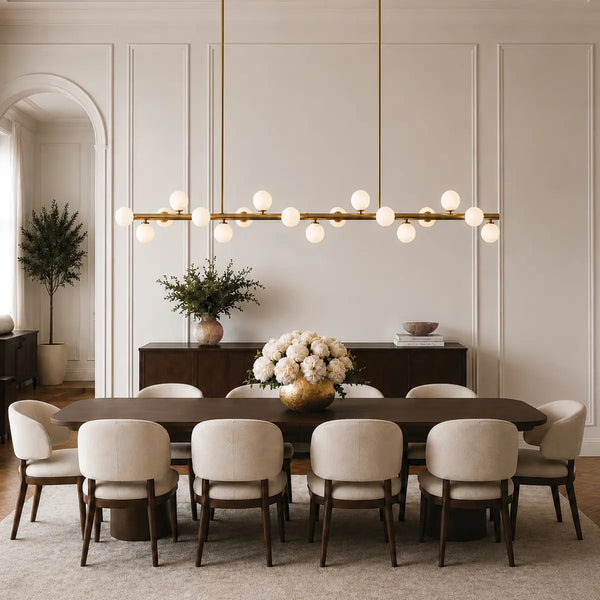
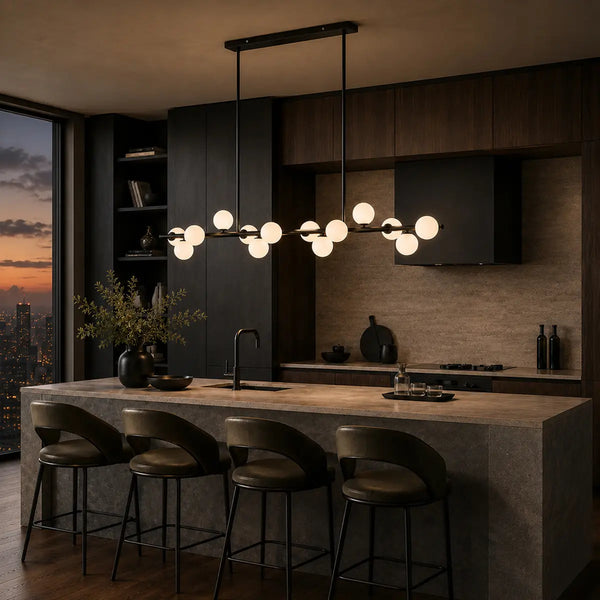
Accent lighting adds depth, warmth and personality. Over an island or breakfast bar, kitchen pendant lights are the jewellery of the room, drawing the eye and defining the space. Brands like Telbix, Domus and Mercator offer pendant styles from sculptural glass and matte-black metal to warm timber and brass tones, so you can match the fitting to your cabinetry and splashback rather than settling for whatever the builder installed.
Pendant sizing and spacing over an island
Getting kitchen island lighting right is mostly a matter of proportion and rhythm. A few reliable rules of thumb:
- Height: hang pendants so the bottom of the shade sits roughly 70–90cm above the benchtop. Low enough to feel intentional and light the surface; high enough that they don't block sightlines across the island.
- Number and spacing: two or three evenly spaced pendants suit most islands. As a guide, space multiple pendants evenly along the island's length and keep them centred over the bench, leaving a comfortable margin at each end so the outer pendants aren't crammed against the edge.
- Scale: one large statement pendant can work beautifully over a compact island, while a longer island generally looks balanced with a row of matching pendants or a single linear fitting.
- Alignment: line pendants up with the centre line of the island, not the ceiling downlights, so the arrangement reads as deliberate from every angle.
When in doubt, err slightly larger and slightly higher rather than small and low. Undersized pendants floating over a big island are the most common styling misstep we see.
Under-cabinet and strip lighting
If you only add one thing to an existing kitchen, make it under-cabinet lighting. Mounted beneath your overhead cabinets, LED strip or slimline bar lighting throws clean, even light straight onto the benchtop with zero shadow, transforming both how the kitchen works and how the splashback looks after dark. SAL and Domus both offer LED strip and cabinet lighting systems designed for exactly this.
Strip lighting also earns its keep in other spots: above cabinets for a soft uplit glow, inside glass-front or open shelving to highlight glassware, and along a toe-kick or plinth for a floating, low-level night light. Choose a warm-white strip with a good spread, tuck the profile behind the cabinet lip so you see the light and not the diode, and where possible run it on the same dimming circuit as your other layers.
Colour temperature for kitchens
Colour temperature, measured in kelvin (K), sets the entire mood of the room. For kitchens we generally recommend warm white, around 3000K. It's crisp enough to keep the space feeling clean and functional but warm enough to stay inviting when the kitchen doubles as a living and entertaining zone, as most Australian open-plan kitchens do.
Very cool, bluish light (4000K and above) can feel clinical at home, while very warm light below 2700K can make a busy workspace feel dim. If you love a warmer glow but still want punch for prep work, look at tri-colour or adjustable-temperature fittings from Mercator, SAL and Brilliant that switch between warm and cool at the flick of a wall switch. Whatever you choose, keep the colour temperature consistent across all your fittings, mismatched whites in the one room are instantly noticeable.
Dimming and smart control
Layered lighting only reaches its full potential when you can control the layers independently. At a minimum, put your ambient downlights and your feature pendants on separate switches so you can drop the general light and let the island pendants take over for dinner. Add dimming and the same kitchen shifts effortlessly from bright morning-prep mode to a soft evening ambience.
Smart control takes it further. Many fittings from Brilliant and Mercator work with app or voice control and scheduling, so you can set scenes, dim by zone and even change colour temperature without rewiring. If you're going down the dimmable or smart path, confirm your chosen LED fittings and driver are compatible with the dimmer or smart system before you buy, this is one area where matching components matters.
IP ratings: what to use over the sink
The area directly above a sink can be exposed to steam and splashes, so fittings there should carry a suitable IP (Ingress Protection) rating rather than a standard indoor rating. As a rule, use an appropriately IP-rated downlight or fitting over the sink and cooktop zone, and follow the manufacturer's placement guidance. Because this touches on electrical safety and zone requirements, it's always worth confirming the right fitting for the exact position with your licensed electrician, and of course all fixed kitchen lighting should be installed by one.
Your kitchen lighting layout checklist
- Ambient: a balanced grid of downlights for even, general light across the whole room.
- Task: downlights over the front edge of benches, dedicated light over sink and cooktop, and under-cabinet strip along your main prep runs.
- Accent: pendants over the island or breakfast bar, hung 70–90cm above the bench and centred on the island.
- Colour: a consistent warm white (around 3000K) throughout, or tri-colour fittings if you want flexibility.
- Control: separate switching for each layer, dimming where you can, and smart control if you want scenes and scheduling.
- Safety: appropriately IP-rated fittings over the sink and cooktop, and a licensed electrician for installation.
Bring your layers together
Layered lighting is what separates a kitchen that merely works from one that feels considered and welcoming. Get the three layers talking to each other, choose fittings that suit your style, and you'll have a space that's a pleasure to cook and gather in at any hour.
Ready to plan yours? Shop kitchen lighting from trusted brands including Telbix, Domus, SAL, Mercator and Brilliant, or browse our full range of pendant lights for the perfect island statement. We offer fast Australia-wide delivery, and if you'd like to see fittings in person, our lighting specialists would love to help you at the Lights For You showroom in Ashfield, Sydney.
Frequently asked questions
How many downlights do I need in my kitchen?
It depends on the size and shape of your kitchen, the ceiling height and how much natural light you get. The goal is even coverage with no dark corners, and downlights positioned over the front edge of benches rather than the walkway so you don't work in your own shadow. A licensed electrician can help you finalise a spacing plan for your specific layout.
How high should I hang pendant lights over a kitchen island?
As a general guide, hang pendants so the bottom of the shade sits roughly 70–90cm above the benchtop. That's low enough to light the surface and feel intentional, but high enough to keep clear sightlines across the island. Centre them on the island and space multiple pendants evenly along its length.
What colour temperature is best for a kitchen?
Warm white, around 3000K, suits most kitchens. It keeps the space feeling clean and functional while staying inviting for open-plan living. If you want flexibility, tri-colour fittings let you switch between warm and cool white. The key is keeping the colour temperature consistent across all your fittings.
Do I need special lights above the kitchen sink?
The area above a sink can be exposed to steam and splashes, so use an appropriately IP-rated fitting there rather than a standard indoor downlight, and follow the manufacturer's placement guidance. Because this relates to electrical zones and safety, confirm the exact fitting and position with your licensed electrician.
Can I add under-cabinet lighting to an existing kitchen?
Yes, and it's one of the highest-impact upgrades you can make. LED strip and slimline bar lighting from brands like SAL and Domus mount beneath your overhead cabinets to light the benchtop directly with no shadow. A licensed electrician can integrate it with your existing switching and, ideally, your dimming circuit.
Shop Kitchen Lighting at Lights For You
Browse our full Kitchen Lighting range, or start with a few popular picks: